


Gallery of recent studies
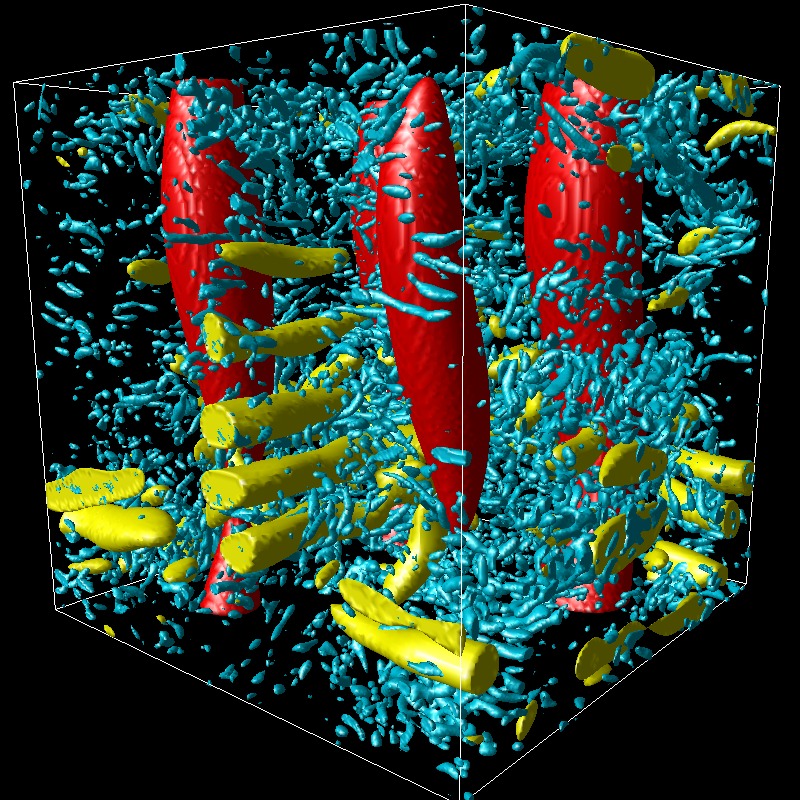
Order in Turbulence (1)
Even in turbulent flows, coherent structures exist. We focus on these coherent structures because we believe that they provide a simple way to understand the complex dynamics of turbulence. Based on this idea, we conduct numerical simulations under a variety of boundary conditions. The video above shows coherent structures in turbulence under periodic boundary conditions. YouTube
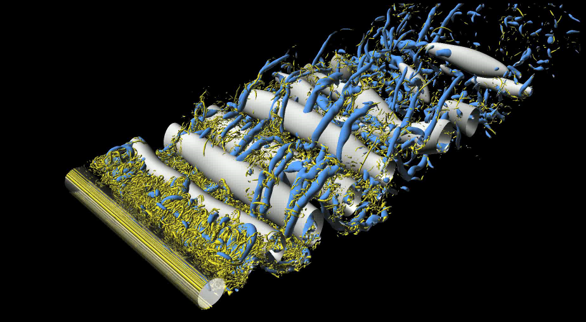
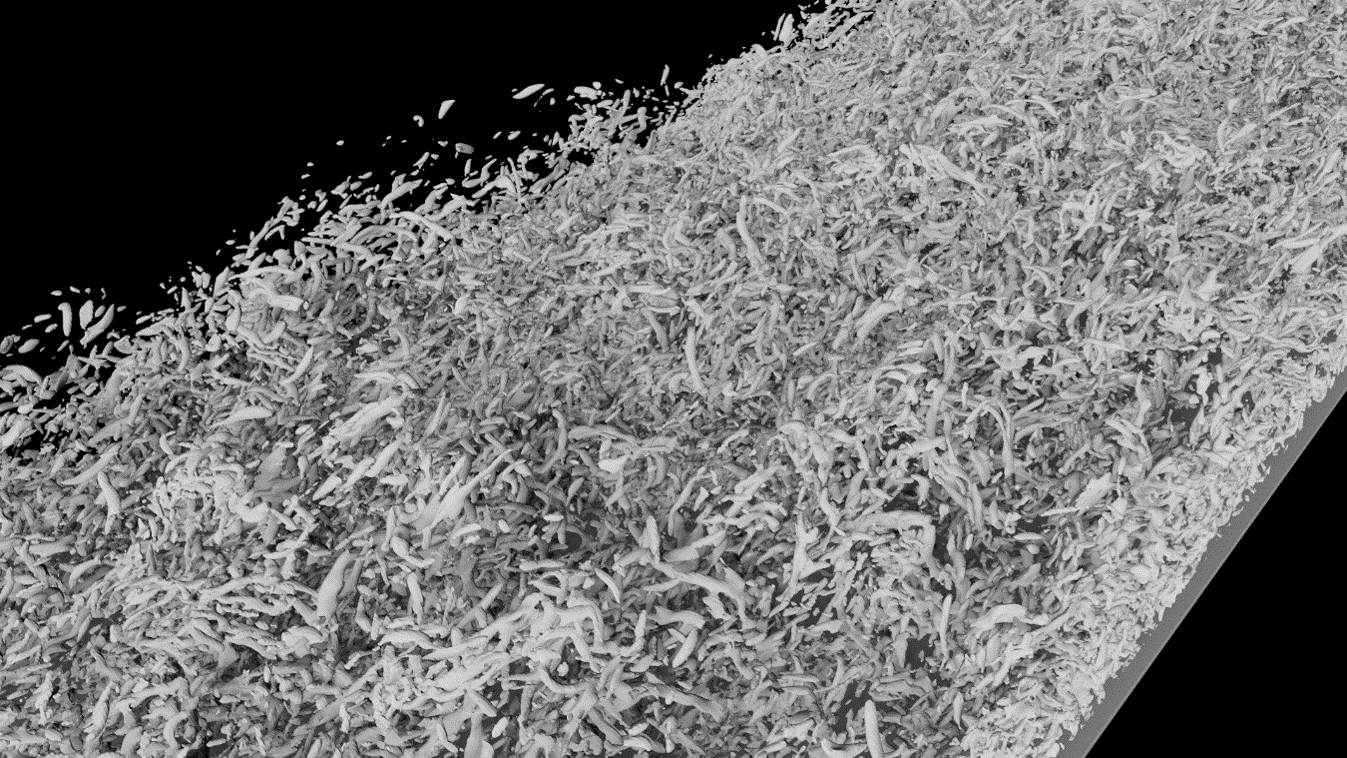
Order in Turbulence (2)
Examples of turbulence near a wall are shown : turbulence behind a circular cylinder (top) and a turbulent boundary layer developing over a flat plate (bottom). Although both flows appear complex at first sight, their dynamics can also be understood well by focusing on coherent structures. Please also watch the explanatory videos on YouTube. YouTube
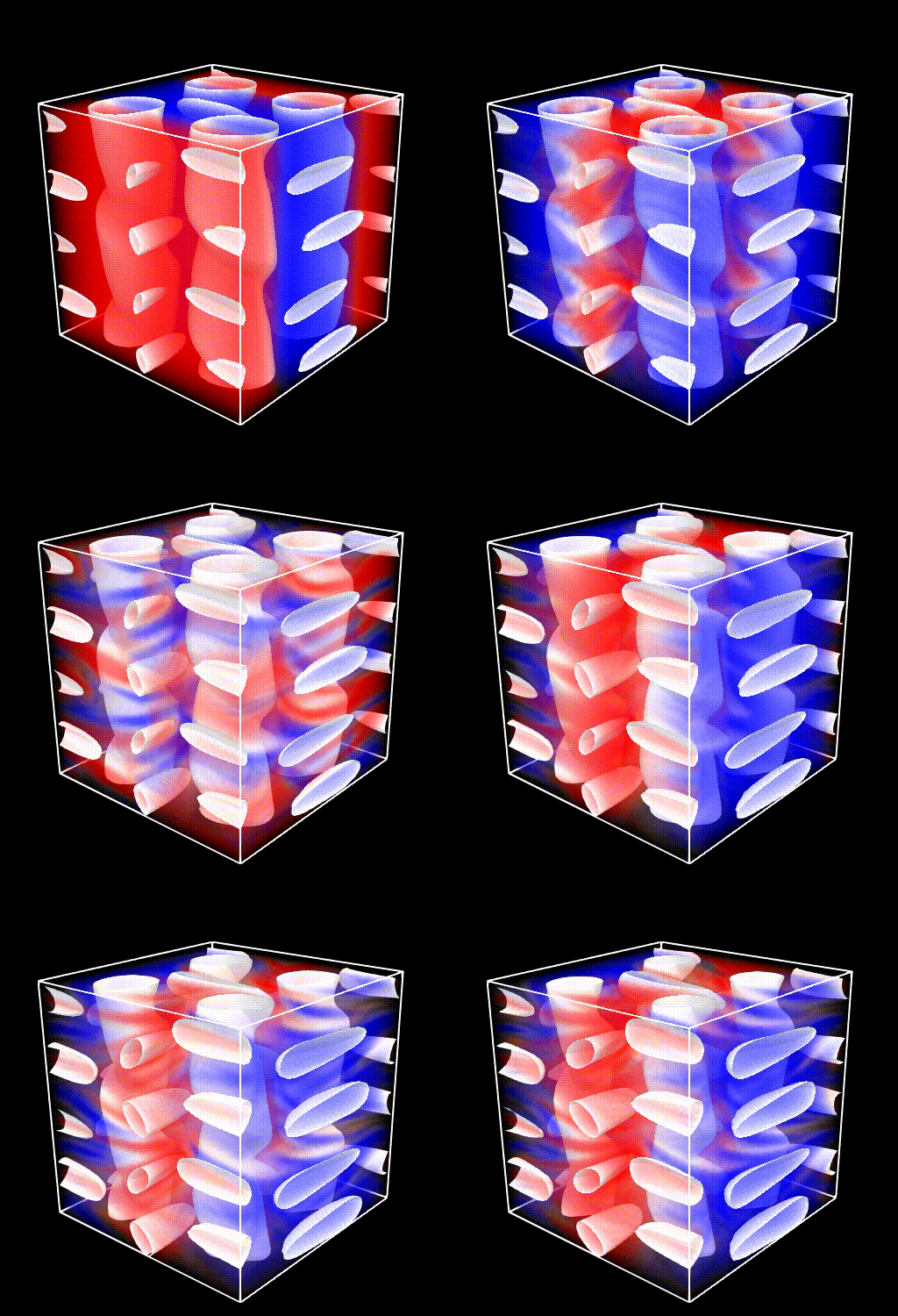
Transport Phenomena by Flow (1)
Although turbulence has a strong ability to transport heat, mass, and other quantities,the underlying physical mechanisms appear complex. By focusing on coherent structures in the flow, however, these complex transport phenomena can sometimes be understood much more easily. From this unique perspective, we are conducting research aimed at a systematic understanding of transport phenomena in flows.
Transport Phenomena in Fluid Flow (2)
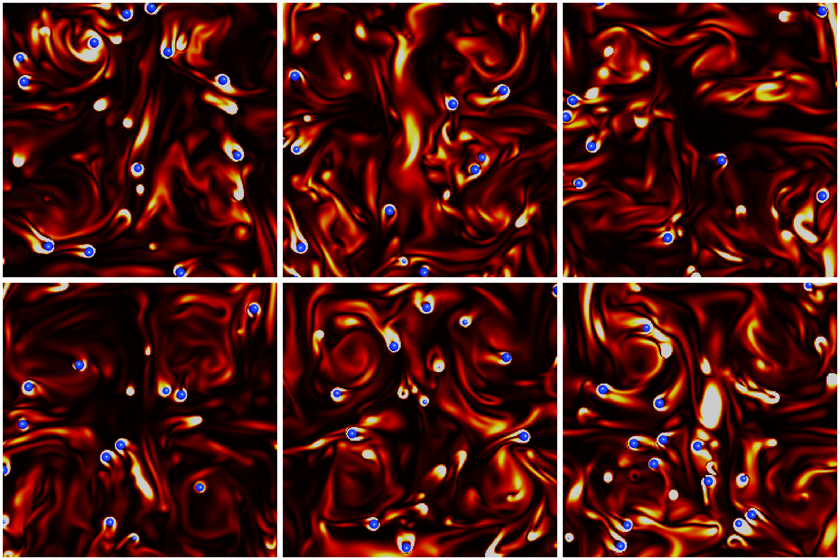
When particles are added to a turbulent flow, the turbulence can sometimes be attenuated. We clarified the physical mechanism of this phenomenon through large-scale numerical simulations.
Transport Phenomena in Fluid Flow (3)
Deformable bodies in a flow, such as elastic bodies, droplets, and bubbles, can exhibit intriguing behaviour. The video above shows an interesting example in which a deformable body is attracted into a vortex.
Non-Newtonian Flow Phenomena
The addition of small amounts of surfactants or polymers to water can dramatically change its flow behavior. These changes arise from the emergence of non-Newtonian properties, such as nonlinear viscosity and elasticity, induced by the additives. Our research aims to elucidate the underlying physics of these phenomena through a combination of numerical simulations, including molecular simulations, and laboratory experiments.
Granular Flows
Granular materials are among the most difficult substances to mix, as illustrated by the well-known Brazil nut effect. From the viewpoint of fluid mechanics, we conduct numerical simulations and laboratory experiments to clarify the flow and mixing behaviour of granular materials. The video above presents a recent example of a stirring technique for granular materials that we discovered through numerical simulation.
Flows with Interfaces (1)
Most fluids around us have interfaces. In particular, very interesting physical phenomena occur near the interface between two fluids such as air and water. Fortunately, owing to recent advances in numerical methods, flows with interfaces can now be simulated quite accurately. We are working to uncover the physical mechanisms of such flows with interfaces.
Flows with Interfaces (2)
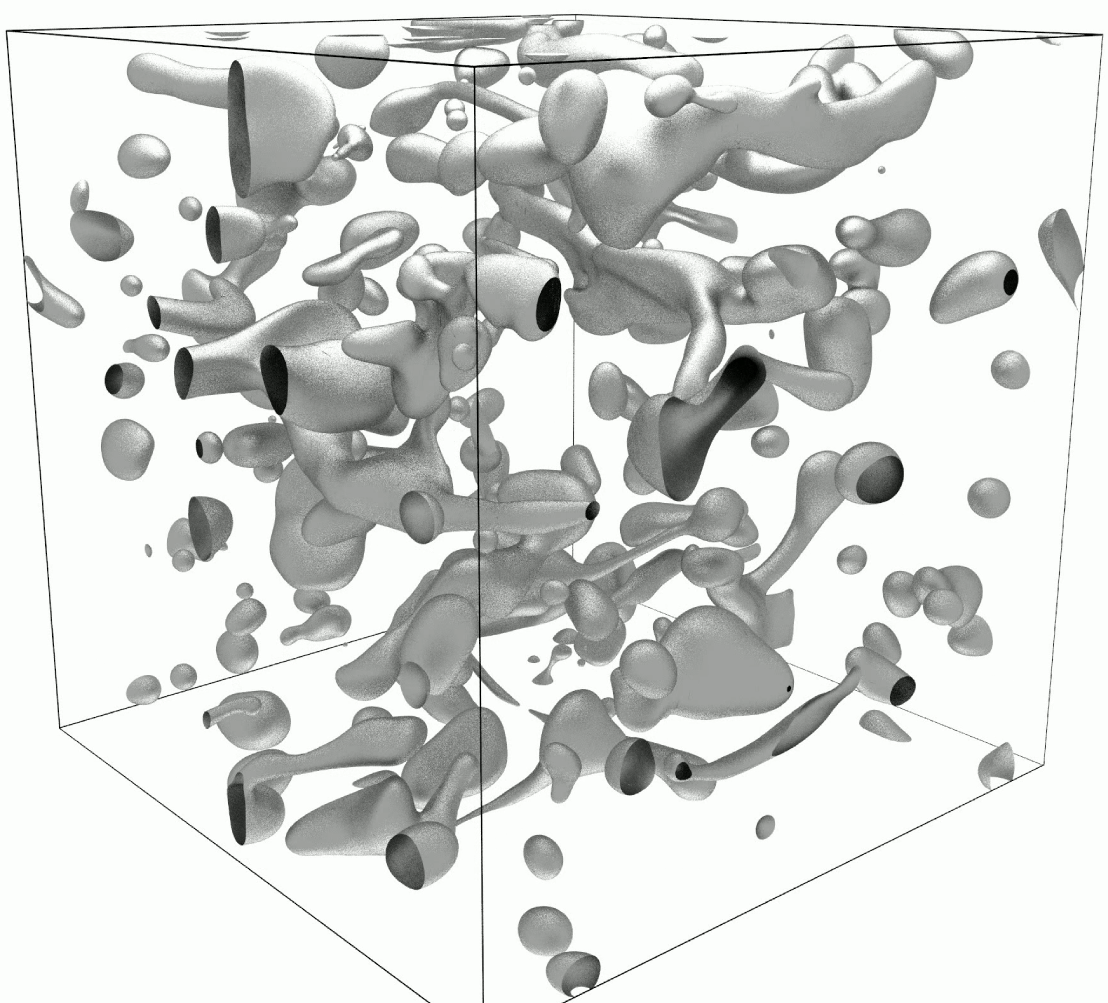
One of the important problems in engineering is the breakup of bubbles and droplets in turbulence. Even such complex phenomena, involving the coexistence of two or more materials, can now be simulated numerically using supercomputers. This is a research area in which further major advances can be expected.
Biofluid Mechanics
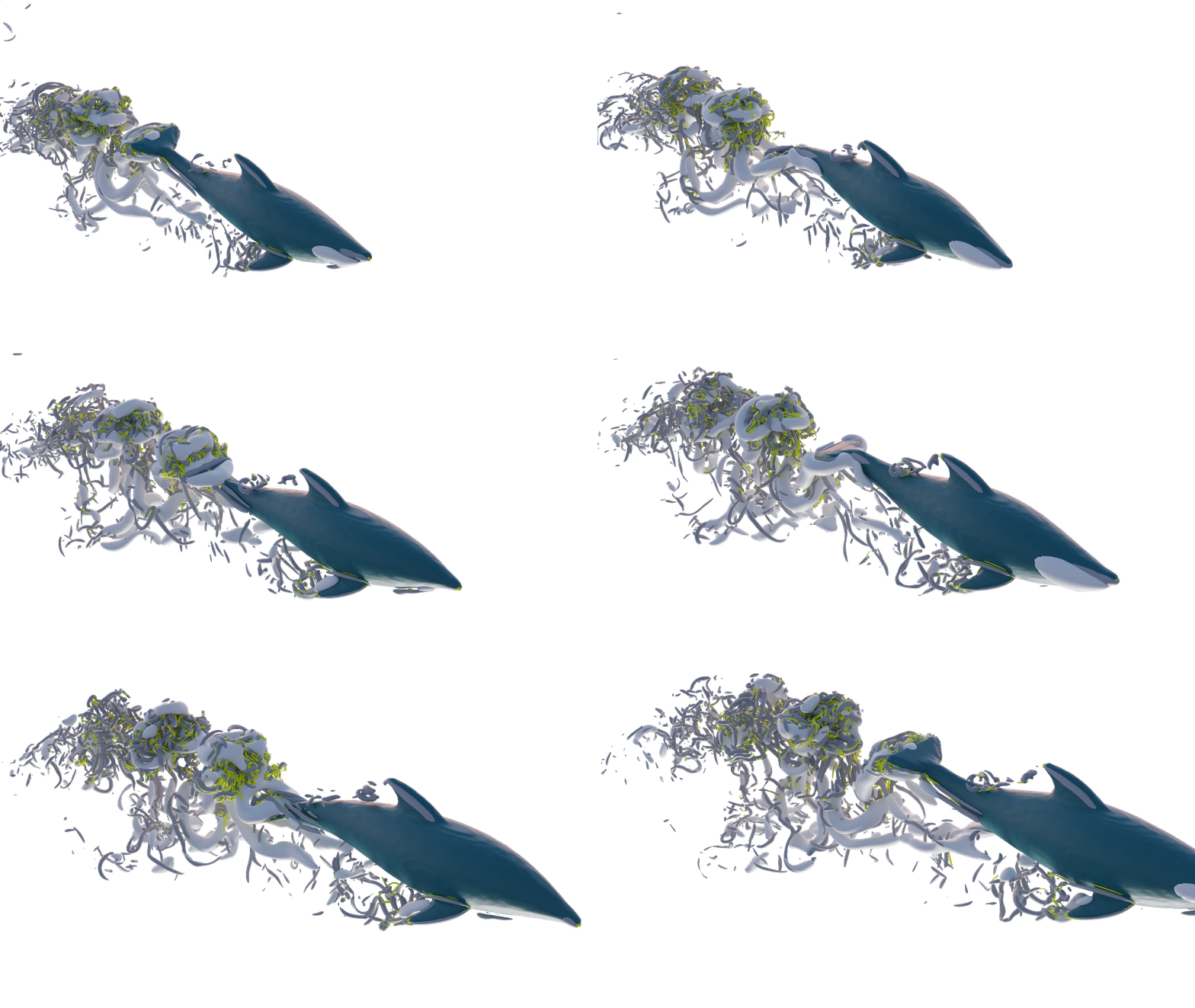
Many living organisms live surrounded by fluids. We aim to understand the complex phenomena arising from interactions between living organisms and fluid flow, and we also conduct research using numerical simulations. The video above shows a dolphin swimming with its tail fin, together with coherent structures in turbulence. Through detailed analysis, we reveal what kinds of vortices the dolphin generates to obtain propulsive force.
Experiments on Well-Controlled Flows
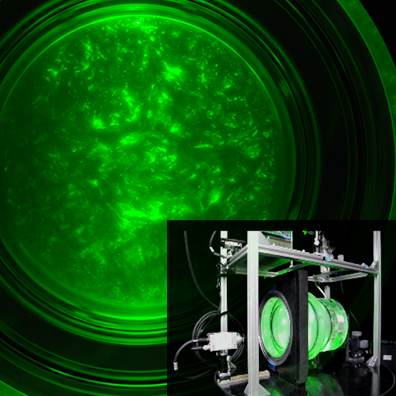
We have found that strong turbulence can be driven inside a fluid-filled container by precessional motion. Our research aims to elucidate the mechanisms that sustain this turbulence, while also exploring its potential for engineering applications. (Experimental video: YouTube)
Development of Mixing Devices
We are developing a new type of mixer by making use of the knowledge gained through our numerical simulations, laboratory experiments, and theoretical studies. In particular, we are committed to proposing mixers without impellers, with the aim of revolutionizing the mixing of liquids and powders.
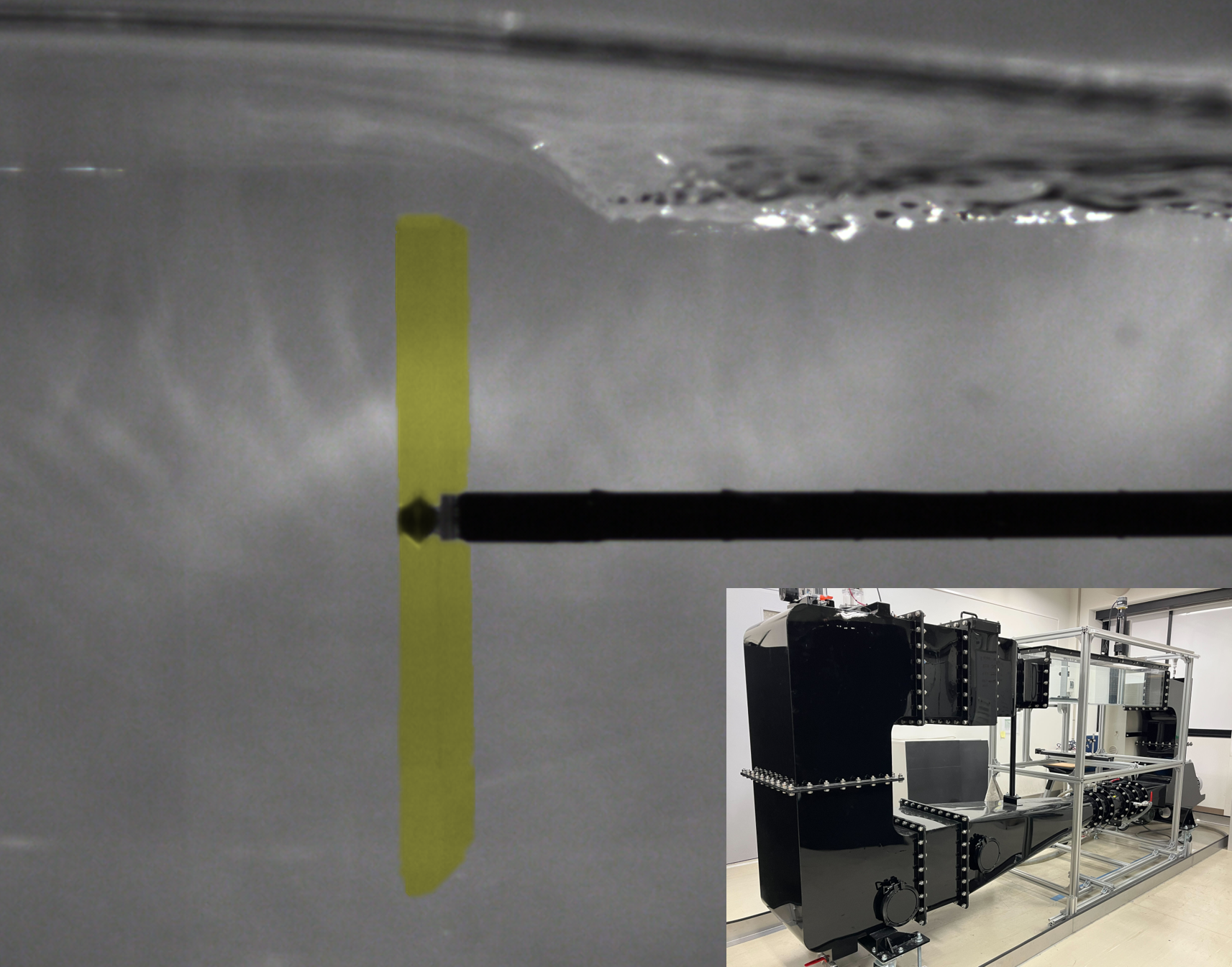
Experiments Using a Circulating Water Channel (1)
Research on flows involving interfaces is expected to become increasingly important. However, we believe that it is difficult to fully elucidate the complex flow phenomena near interfaces using numerical simulations alone. To address this, we actively conduct laboratory experiments using a circulating water channel in parallel with numerical simulations.
Experiments Using a Circulating Water Channel (2)
When a cylindrical object is placed in a circulating water channel, turbulence is sustained in its wake. When a deformable object mimicking a fish is introduced into this turbulent flow, it behaves as if it were alive and occasionally exhibits self-propulsive motion. Such phenomena highlight the intriguing interactions between deformable bodies and turbulence. We are investigating the underlying dynamics of these interactions.
Experiments on Thermal Convection in Rotating Systems
A temperature gradient in a fluid produces density variations, and therefore buoyancy, which in turn drives convection. Thermal convection is a common phenomenon both in nature and in engineering applications. We investigate, through experiments and theoretical analysis, the effects of surface tension and system rotation on thermal convection.
Prediction and Control of Flows Using Machine Learning
Machine learning makes it possible to predict and control flow behavior inductively from data. We combine this data-driven approach with deductive methods based on the physics of flows and governing equations, in order to predict, model, control, and optimize flow phenomena.
Continuum Theory of Granular Materials
Granular materials exhibit both fluid-like and solid-like behavior depending on the conditions, making their dynamics challenging to predict. We study the motion of granular materials within a continuum framework, aiming to uncover the rich and complex phenomena associated with granular flows.
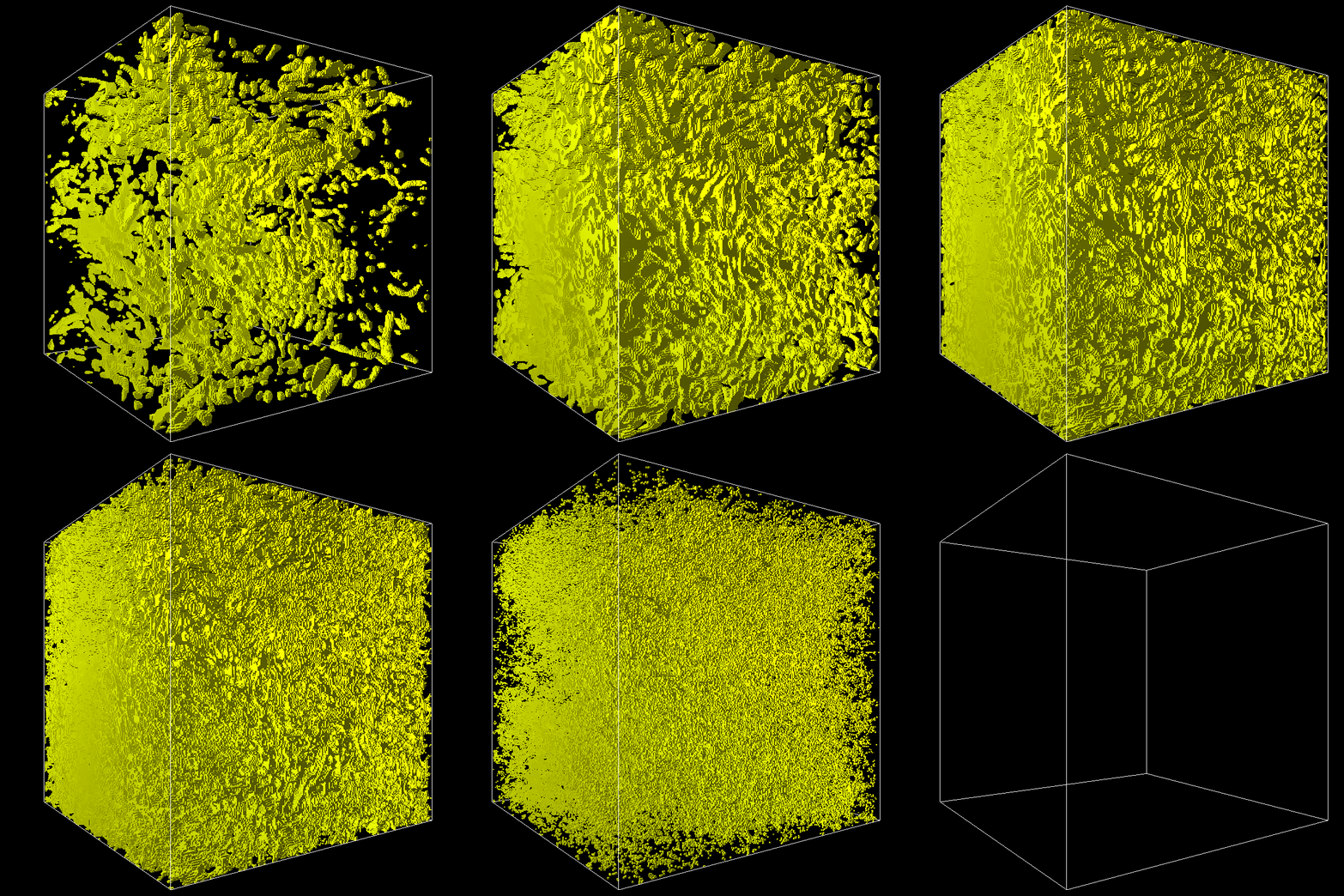
Theoretical Approaches to Strongly Nonlinear Systems
The fluid phenomena discussed above involve strong nonlinearity and nonequilibrium effects, making analytical treatment highly challenging. We aim to construct theoretical frameworks capable of describing and analyzing such complex systems.
